UI / UX Design
Improving UX with Ubiq
Explored Ubiq’s spatial media app by testing features, analyzing usability, and suggesting design improvements. Shared insights on interaction flow, visual design, and ways to enhance user engagement.
Year :
2025
Industry :
Social / Spatial Media
Client :
Ubiq Team
Project Duration :
2 months

OVERVIEW :
Ubiq is a startup building a spatial media platform, an app that allows users to post photos and videos that are tied to specific locations and displayed on a 3D world map. I joined Ubiq as an intern to contribute to early-stage user testing, UX research, and product ideation. My work ranged from testing the app firsthand, providing structured feedback, and answering user experience questions, to developing ideas for new features and addressing technical challenges in the product’s design. Through this internship, I gained hands-on experience in UX research, product ideation, and interactive design for emerging technologies. My contributions helped Ubiq refine the app’s usability, improve how content is visualized on a spatial map, and explore new ways of engaging users through profile features and social media. This experience gave me insight into the challenges of designing for an innovative platform that blends social networking with real-world geography.
USER TESTING AND FEEDBACK :
The internship began with downloading the app, using it in real time, and meeting with the Ubiq team to provide feedback. I was asked to evaluate the app as a new user by answering questions such as:
What works and what does not work
What features are missing
Who would use this app and who would not
What makes the app engaging and what makes it confusing
This process allowed me to critically analyze Ubiq’s onboarding and core interactions. I reported on the overall usability, the clarity of navigation, and the novelty of spatial media as a concept.
PRODUCT LAB CHALLENGES :
After the initial testing phase, I participated in Ubiq’s Product Lab, which included four structured challenges:
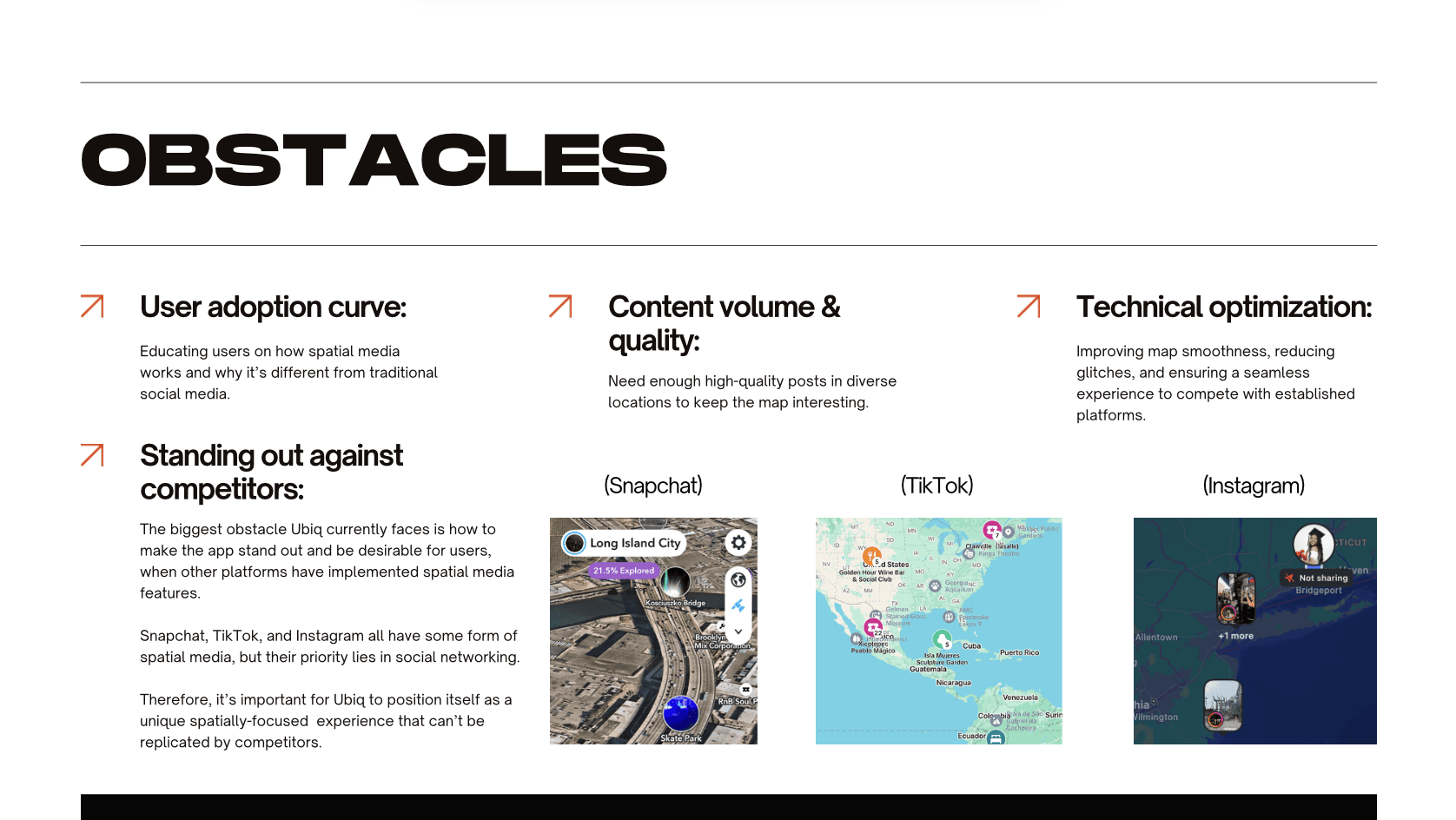
App Evaluation: Summarized strengths and weaknesses of the app, what features were effective, and what areas needed refinement. Suggested fixes and new features to strengthen engagement and usability.
Social Media Integration: Created content for Ubiq’s social channels to test how the app could support marketing and storytelling. This showed how posts created within the app could translate into engaging external campaigns.
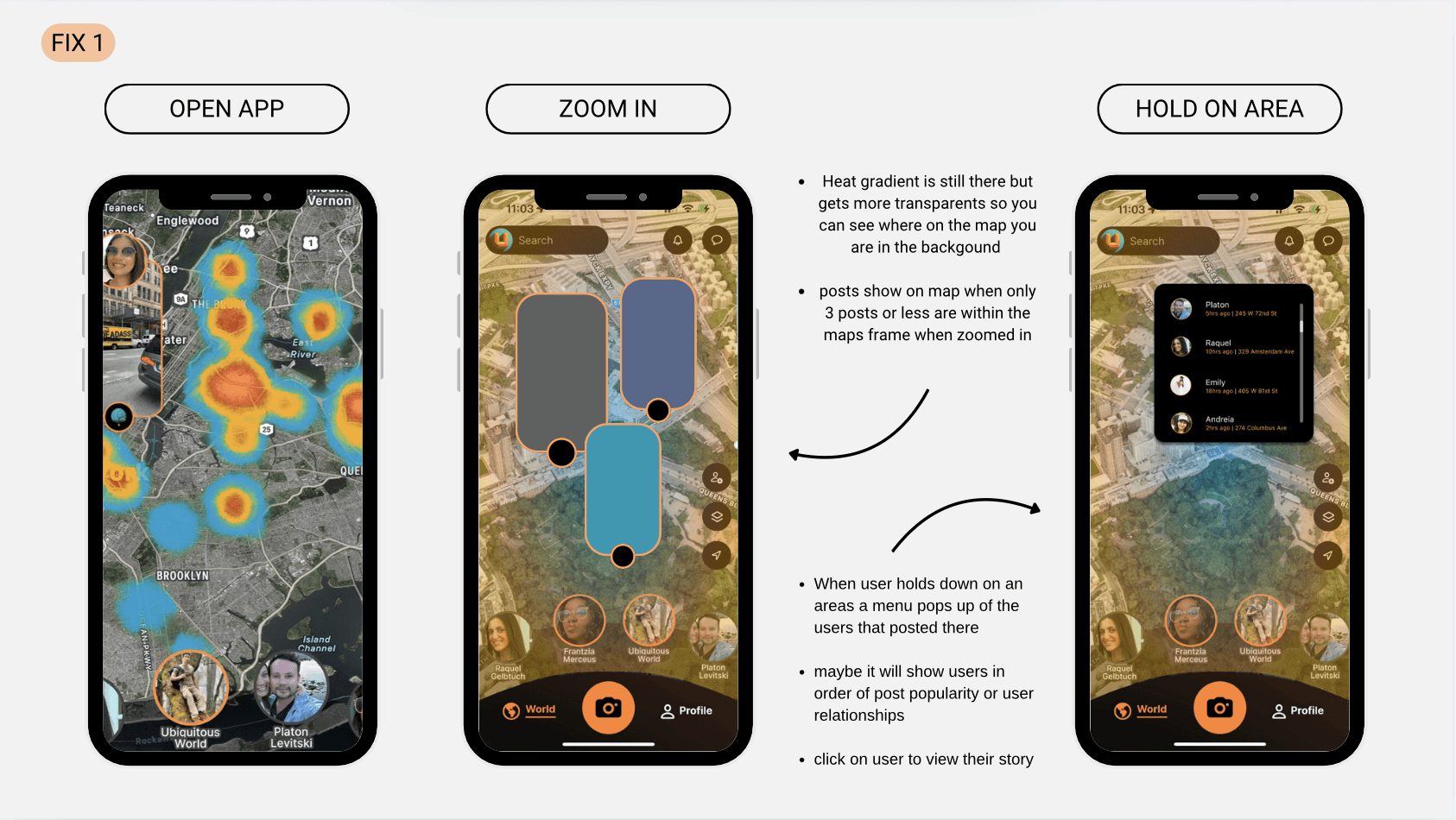
Clustering Problem: The team presented a key UX challenge. Since posts appear on a 3D world map, clusters of posts in one area could become visually overwhelming and make it difficult to see individual content. My group proposed a heat map solution, similar to the Snap Map approach, which would scale posts dynamically. Only posts within a zoomed-in view would be visible, while broader areas would show activity as a color gradient. This helped solve the clutter issue while retaining spatial context.
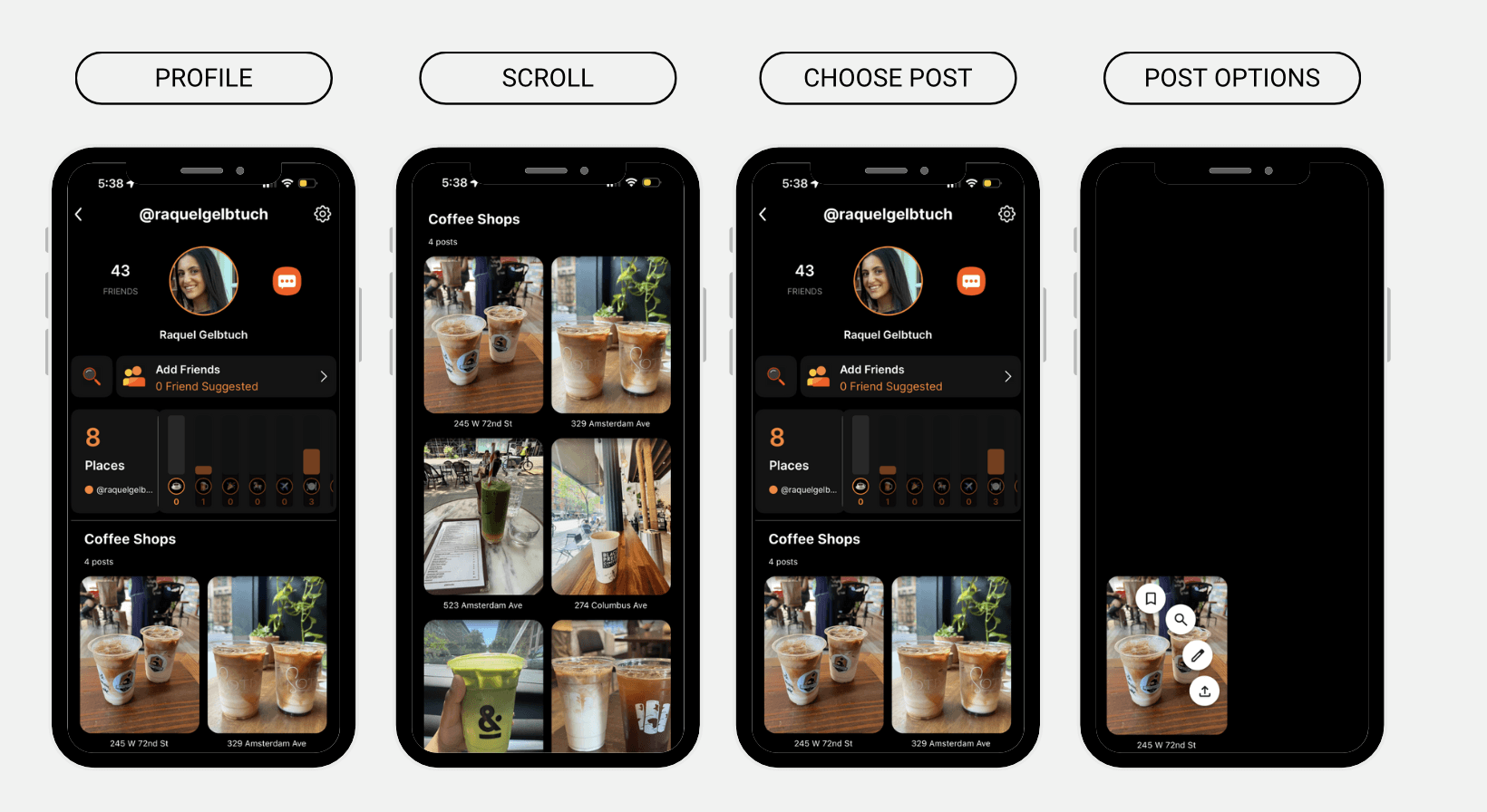
New Feature Ideation: I designed a feature concept for user profiles. Each profile already had emoji markers (such as a coffee cup for cafés or a shopping bag for retail) showing categories of places where posts were made. My idea was to let users create category boards, similar to Pinterest, where their posts would be organized into themed collections like “Shopping,” “Coffee Shops,” or “Travel Spots.” Users could share, explore, and engage with posts by category, and discover related posts from others in the same area. This feature makes it easier to navigate content, explore favorite places, and build community around shared interests.
More Projects


UI / UX Design
Improving UX with Ubiq
Explored Ubiq’s spatial media app by testing features, analyzing usability, and suggesting design improvements. Shared insights on interaction flow, visual design, and ways to enhance user engagement.
Year :
2025
Industry :
Social / Spatial Media
Client :
Ubiq Team
Project Duration :
2 months
OVERVIEW :
Ubiq is a startup building a spatial media platform, an app that allows users to post photos and videos that are tied to specific locations and displayed on a 3D world map. I joined Ubiq as an intern to contribute to early-stage user testing, UX research, and product ideation. My work ranged from testing the app firsthand, providing structured feedback, and answering user experience questions, to developing ideas for new features and addressing technical challenges in the product’s design. Through this internship, I gained hands-on experience in UX research, product ideation, and interactive design for emerging technologies. My contributions helped Ubiq refine the app’s usability, improve how content is visualized on a spatial map, and explore new ways of engaging users through profile features and social media. This experience gave me insight into the challenges of designing for an innovative platform that blends social networking with real-world geography.
USER TESTING AND FEEDBACK :
The internship began with downloading the app, using it in real time, and meeting with the Ubiq team to provide feedback. I was asked to evaluate the app as a new user by answering questions such as:
What works and what does not work
What features are missing
Who would use this app and who would not
What makes the app engaging and what makes it confusing
This process allowed me to critically analyze Ubiq’s onboarding and core interactions. I reported on the overall usability, the clarity of navigation, and the novelty of spatial media as a concept.
PRODUCT LAB CHALLENGES :
After the initial testing phase, I participated in Ubiq’s Product Lab, which included four structured challenges:
App Evaluation: Summarized strengths and weaknesses of the app, what features were effective, and what areas needed refinement. Suggested fixes and new features to strengthen engagement and usability.
Social Media Integration: Created content for Ubiq’s social channels to test how the app could support marketing and storytelling. This showed how posts created within the app could translate into engaging external campaigns.
Clustering Problem: The team presented a key UX challenge. Since posts appear on a 3D world map, clusters of posts in one area could become visually overwhelming and make it difficult to see individual content. My group proposed a heat map solution, similar to the Snap Map approach, which would scale posts dynamically. Only posts within a zoomed-in view would be visible, while broader areas would show activity as a color gradient. This helped solve the clutter issue while retaining spatial context.
New Feature Ideation: I designed a feature concept for user profiles. Each profile already had emoji markers (such as a coffee cup for cafés or a shopping bag for retail) showing categories of places where posts were made. My idea was to let users create category boards, similar to Pinterest, where their posts would be organized into themed collections like “Shopping,” “Coffee Shops,” or “Travel Spots.” Users could share, explore, and engage with posts by category, and discover related posts from others in the same area. This feature makes it easier to navigate content, explore favorite places, and build community around shared interests.
More Projects
UI / UX Design
Improving UX with Ubiq
Explored Ubiq’s spatial media app by testing features, analyzing usability, and suggesting design improvements. Shared insights on interaction flow, visual design, and ways to enhance user engagement.
Year :
2025
Industry :
Social / Spatial Media
Client :
Ubiq Team
Project Duration :
2 months
OVERVIEW :
Ubiq is a startup building a spatial media platform, an app that allows users to post photos and videos that are tied to specific locations and displayed on a 3D world map. I joined Ubiq as an intern to contribute to early-stage user testing, UX research, and product ideation. My work ranged from testing the app firsthand, providing structured feedback, and answering user experience questions, to developing ideas for new features and addressing technical challenges in the product’s design. Through this internship, I gained hands-on experience in UX research, product ideation, and interactive design for emerging technologies. My contributions helped Ubiq refine the app’s usability, improve how content is visualized on a spatial map, and explore new ways of engaging users through profile features and social media. This experience gave me insight into the challenges of designing for an innovative platform that blends social networking with real-world geography.
USER TESTING AND FEEDBACK :
The internship began with downloading the app, using it in real time, and meeting with the Ubiq team to provide feedback. I was asked to evaluate the app as a new user by answering questions such as:
What works and what does not work
What features are missing
Who would use this app and who would not
What makes the app engaging and what makes it confusing
This process allowed me to critically analyze Ubiq’s onboarding and core interactions. I reported on the overall usability, the clarity of navigation, and the novelty of spatial media as a concept.
PRODUCT LAB CHALLENGES :
After the initial testing phase, I participated in Ubiq’s Product Lab, which included four structured challenges:
App Evaluation: Summarized strengths and weaknesses of the app, what features were effective, and what areas needed refinement. Suggested fixes and new features to strengthen engagement and usability.
Social Media Integration: Created content for Ubiq’s social channels to test how the app could support marketing and storytelling. This showed how posts created within the app could translate into engaging external campaigns.
Clustering Problem: The team presented a key UX challenge. Since posts appear on a 3D world map, clusters of posts in one area could become visually overwhelming and make it difficult to see individual content. My group proposed a heat map solution, similar to the Snap Map approach, which would scale posts dynamically. Only posts within a zoomed-in view would be visible, while broader areas would show activity as a color gradient. This helped solve the clutter issue while retaining spatial context.
New Feature Ideation: I designed a feature concept for user profiles. Each profile already had emoji markers (such as a coffee cup for cafés or a shopping bag for retail) showing categories of places where posts were made. My idea was to let users create category boards, similar to Pinterest, where their posts would be organized into themed collections like “Shopping,” “Coffee Shops,” or “Travel Spots.” Users could share, explore, and engage with posts by category, and discover related posts from others in the same area. This feature makes it easier to navigate content, explore favorite places, and build community around shared interests.